Not many people know it, but I am a survivor of a real-life horror story, chronicled in a website I recently created, marthacorey-ochoa.com.
In 2008, when she was fourteen, my brilliant and beautiful daughter, Martha Corey-Ochoa, read in a book about an eighteenth-century Russian prince named Aleksei Petrovich Romanov, who was tortured to death by his father, Tsar Peter the Great. (Aleksei really existed, you can look him up here.) Martha fell in love with Aleksei, despite the three-century gap in their ages, and believed that he loved her back. She considered herself his wife and widow, and often wore black in mourning. She put a toy plastic silver ring on her finger as her wedding ring.
Martha experienced heights of ecstasy in her love affair with Aleksei, and suicidal depths of depression at his absence. She physically felt his touch. Her marriage to him separated her from her friends and kept her from pursuing romances with living boys. She kept her love a secret from my wife and me until June 3, 2009, when she told us about him. I had her see a psychiatrist, who diagnosed her with an unspecified mood disorder with psychotic features that was probably bipolar disorder. From then on she was under psychiatric treatment, including psychotropic drugs and psychotherapy.
In 2010, Martha was torn between her love of Aleksei and her desire for a living boy, Yihan, and attempted suicide by drinking laundry detergent. She survived, but fell into a deep depression. She believed herself to have been unfaithful to Aleksei and to have lost him as a result. She considered suicide again in 2011, and spent a month in a mental hospital. Finally, on August 27, 2012, at the age of eighteen, she committed suicide by throwing herself out the fourteenth-story window of her dorm room on her first night at Columbia University. Her death made international news, even reaching the London press.
I will never know exactly why Martha killed herself, but I believe that Aleksei played a role. If what she said was true, then the ghost of this Russian prince was a deformed destructive being (a DDB), deformed positionally (because he still lived even though he was dead), destructive in the effects he had on her. If he was only a delusion caused by mental illness, then Martha herself was the DDB, deformed psychologically in such a way that she destroyed herself.
Martha enjoyed the movie Bram Stoker's Dracula, because it bore such similarities to her own life: eastern European undead prince has love affair with living girl that leaves her forever marked. She was also partial to Twilight and its sequels, again because of the love affair between the undead male and the living female.
The only difference between Martha's horror story and the ones I've seen in movies is that the effect on me was not horror, but grief. I lost my only child to this monster. Still, she lives on in my memories, and to honor her, I created a website of her writings--poems, essays, journals, fiction--most of which focus on or are inspired by her marriage to Aleksei. I encourage you to visit the site: marthacorey-ochoa.com.
George Ochoa
A blog about horror films and their deformed and destructive beings (ie, monsters). Beware of spoilers.
Sunday, July 10, 2016
Saturday, June 6, 2015
Mary and the Living Dead
One of the things I like about Jon Towlson's book Subversive Horror Cinema is how it directs me to horror films I haven't seen yet. Here are two of them I recently saw: American Mary (2012) and Survival of the Dead (2009).
American Mary is about a medical student named Mary, who, when trying to make ends meet, finds a profitable career doing body-modification surgery for people desperate to alter their bodies: identical twins who want to swap limbs; a woman who wants a forked tongue; people who don't like their genitalia; and so on. She is doing so well she quits medical school and goes to work full-time as an underground surgeon. And she has another secret: she is getting diabolical revenge on Dr. Grant, a surgeon who raped her, She performs 14 hours of surgery on him, without anesthesia, hacking off his arms and legs, sewing his mouth shut, and keeping him locked up until she can think of more things to do to him.

Mary qualifies as a deformed-destructive being (DDB) if only for the cruelty of the revenge she takes on Dr. Grant, putting herself in the category of rape-revenge horror movie vixens such as Jennifer, the star of I Spit on Your Grave. About her other surgeries, however, there is some uncertainty. Is it truly destructive to cut up and deform a body when the owner of the body wants it done and is willing to pay for it? Perhaps not, if one considers it from the point of view of American capitalism (as the title of this movie suggests). Americans highly value the right of the individual to the pursuit of happiness, and what will make these patients happy is bod-mod surgery. Further, the sanctity of private economic transactions is what the USA is all about, and Mary is engaging in such transactions with her patients. So, from that point of view, she is not a DDB for being a bod-mod surgeon.
Still, if one believes there is a natural order to things, and that destroying parts of a human body and deforming it for non-medical reasons is a violation of that order, then Mary is a DDB just because of the body modifications she carries out. This is why viewers of this film cringe when she carries them out: belief in a natural order is deep inside us, deeper even than capitalism. There are at least two warring final vocabularies at work in this movie--American capitalist and medieval great chain of being--and the clash of them produces the uneasy mix of horror and humor that this film skillfully delivers.
The other film I recently saw, Survival of the Dead, is neither as inventive nor as horrifying as American Mary.

This is the sixth film in the George A. Romero series that began with Night of the Living Dead, and enough is enough. Even the original Planet of the Apes series only lasted for five films. The shambling, ravenous zombies are at it again, this time trying to eat a military unit and two warring families on Plum Island. The film moves right along and is, as were the earlier films, entertaining (except for Diary of the Dead, which was not), but there is nothing substantially new here, and the stakes are low. It's essentially a Hatfield and McCoy film, and who really cares which side of that struggle won?
The DDBs in Survival of the Dead, are, I suppose, the zombies, but by this point they have only a faint supply of deformity and destructiveness. We have seen them many times before, in this series and its many imitators, and we know how to kill them and avoid them. The horror is all but gone. It's like what happened to the Frankenstein monster by the time Abbott and Costello met up with him in Abbott and Costello Meet Frankenstein.
At the end of the film there's a bit of social satire about the futility of war. This bit is itself futile. You don't make six movies about zombies vs. humans if you really think violent conflict is futile. On the contrary, it can be quite lucrative.
George Ochoa
American Mary is about a medical student named Mary, who, when trying to make ends meet, finds a profitable career doing body-modification surgery for people desperate to alter their bodies: identical twins who want to swap limbs; a woman who wants a forked tongue; people who don't like their genitalia; and so on. She is doing so well she quits medical school and goes to work full-time as an underground surgeon. And she has another secret: she is getting diabolical revenge on Dr. Grant, a surgeon who raped her, She performs 14 hours of surgery on him, without anesthesia, hacking off his arms and legs, sewing his mouth shut, and keeping him locked up until she can think of more things to do to him.
Mary qualifies as a deformed-destructive being (DDB) if only for the cruelty of the revenge she takes on Dr. Grant, putting herself in the category of rape-revenge horror movie vixens such as Jennifer, the star of I Spit on Your Grave. About her other surgeries, however, there is some uncertainty. Is it truly destructive to cut up and deform a body when the owner of the body wants it done and is willing to pay for it? Perhaps not, if one considers it from the point of view of American capitalism (as the title of this movie suggests). Americans highly value the right of the individual to the pursuit of happiness, and what will make these patients happy is bod-mod surgery. Further, the sanctity of private economic transactions is what the USA is all about, and Mary is engaging in such transactions with her patients. So, from that point of view, she is not a DDB for being a bod-mod surgeon.
Still, if one believes there is a natural order to things, and that destroying parts of a human body and deforming it for non-medical reasons is a violation of that order, then Mary is a DDB just because of the body modifications she carries out. This is why viewers of this film cringe when she carries them out: belief in a natural order is deep inside us, deeper even than capitalism. There are at least two warring final vocabularies at work in this movie--American capitalist and medieval great chain of being--and the clash of them produces the uneasy mix of horror and humor that this film skillfully delivers.
The other film I recently saw, Survival of the Dead, is neither as inventive nor as horrifying as American Mary.
This is the sixth film in the George A. Romero series that began with Night of the Living Dead, and enough is enough. Even the original Planet of the Apes series only lasted for five films. The shambling, ravenous zombies are at it again, this time trying to eat a military unit and two warring families on Plum Island. The film moves right along and is, as were the earlier films, entertaining (except for Diary of the Dead, which was not), but there is nothing substantially new here, and the stakes are low. It's essentially a Hatfield and McCoy film, and who really cares which side of that struggle won?
The DDBs in Survival of the Dead, are, I suppose, the zombies, but by this point they have only a faint supply of deformity and destructiveness. We have seen them many times before, in this series and its many imitators, and we know how to kill them and avoid them. The horror is all but gone. It's like what happened to the Frankenstein monster by the time Abbott and Costello met up with him in Abbott and Costello Meet Frankenstein.
At the end of the film there's a bit of social satire about the futility of war. This bit is itself futile. You don't make six movies about zombies vs. humans if you really think violent conflict is futile. On the contrary, it can be quite lucrative.
George Ochoa
Saturday, May 2, 2015
Book Review: Jon Towlson's Subversive Horror Cinema
Book Review
Jon Towlson
Subversive Horror Cinema: Countercultural Messages of Films from Frankenstein to the Present
McFarland 2014
Subversive Horror Cinema has almost everything that one looks for in a book on horror movies. It reminds you of horror movies you've seen and gives you information on movies you haven't seen. It has a nice collection of stills, an interesting premise (that there exists a tradition of subversive horror movies), and a capable style. This all makes for an entertaining voyage into horror moviedom.
The one thing it lacks is variety in the analysis of films. This is because the movies Towlson discusses are all chosen as examples of one thing: subversiveness. Towlson defines the "subversive school of horror" as "a more radical wing of the genre involving its ideological use for potentially progressive purposes." Two words in this definition stick out: "radical" and "progressive." In America, at least, these are terms of approbation frequently used by left-wingers to refer to themselves. So what this definition really means is "the left wing of the genre." I ought to know; I have been a left-winger all my adult life. As a young man, I believed in anarchism, and now I'm a member of the next closest thing, the Democratic Party. Therefore, I don't mind that some films in the horror genre have a left-wing bent, nor that there is now a book about them. What I mind is how monotonous the book gets when every analysis of a film tries to show the film's subversiveness.
Just about every discussion of a film in Subversive Horror Cinema reaches the same conclusion: it's attacking patriarchy, government, religion, racism, repression, individualism, misogyny, the military, or some other thing some left-wingers oppose. All the other horror movies--the majority of them, says Towlson--"can and should be considered reactionary." "Reactionary" is another buzzword, like "radical" and "progressive." All it means is "right-winger."
Thus, Frankenstein makes the cut, because it undermines heterosexuality, eugenics, and aristocracy; Frankenstein Meets the Wolf Man does not. Night of the Living Dead, yes, because it attacks government, racism, and the Vietnam War; Fright Night, no. Indeed Towlson saves most of the good films for his subversive list, and leaves the junk to the rest of us.
In my book on horror films, Deformed and Destructive Beings: The Purpose of Horror Films, I mention that deformed and destructive beings (ie, monsters) are constructed out of subversive materials. But my use of "subversive" is more in line with its dictionary definition of "intending to undermine an established order." Such an order need not be political; it can be the order of nature, such as the human genetic code subverted in The Fly (1986). Had Towlson followed this definition of subversive, his book might not have been better, but the analyses would have been more varied.
There are a few other imperfections in this book. For example, Towlson reports that Reagan was elected president in 1979, whereas the correct year was 1980. And I recently saw a movie called Girly (1970) that I thought Towlson would want to analyze, but he didn't seem to include it. Then I found it in the book under its original British title, Mumsy, Nanny, Sonny and Girly. He did have it. Maybe he is perfect.
George Ochoa
Jon Towlson
Subversive Horror Cinema: Countercultural Messages of Films from Frankenstein to the Present
McFarland 2014
Subversive Horror Cinema has almost everything that one looks for in a book on horror movies. It reminds you of horror movies you've seen and gives you information on movies you haven't seen. It has a nice collection of stills, an interesting premise (that there exists a tradition of subversive horror movies), and a capable style. This all makes for an entertaining voyage into horror moviedom.
The one thing it lacks is variety in the analysis of films. This is because the movies Towlson discusses are all chosen as examples of one thing: subversiveness. Towlson defines the "subversive school of horror" as "a more radical wing of the genre involving its ideological use for potentially progressive purposes." Two words in this definition stick out: "radical" and "progressive." In America, at least, these are terms of approbation frequently used by left-wingers to refer to themselves. So what this definition really means is "the left wing of the genre." I ought to know; I have been a left-winger all my adult life. As a young man, I believed in anarchism, and now I'm a member of the next closest thing, the Democratic Party. Therefore, I don't mind that some films in the horror genre have a left-wing bent, nor that there is now a book about them. What I mind is how monotonous the book gets when every analysis of a film tries to show the film's subversiveness.
Just about every discussion of a film in Subversive Horror Cinema reaches the same conclusion: it's attacking patriarchy, government, religion, racism, repression, individualism, misogyny, the military, or some other thing some left-wingers oppose. All the other horror movies--the majority of them, says Towlson--"can and should be considered reactionary." "Reactionary" is another buzzword, like "radical" and "progressive." All it means is "right-winger."
Thus, Frankenstein makes the cut, because it undermines heterosexuality, eugenics, and aristocracy; Frankenstein Meets the Wolf Man does not. Night of the Living Dead, yes, because it attacks government, racism, and the Vietnam War; Fright Night, no. Indeed Towlson saves most of the good films for his subversive list, and leaves the junk to the rest of us.
In my book on horror films, Deformed and Destructive Beings: The Purpose of Horror Films, I mention that deformed and destructive beings (ie, monsters) are constructed out of subversive materials. But my use of "subversive" is more in line with its dictionary definition of "intending to undermine an established order." Such an order need not be political; it can be the order of nature, such as the human genetic code subverted in The Fly (1986). Had Towlson followed this definition of subversive, his book might not have been better, but the analyses would have been more varied.
There are a few other imperfections in this book. For example, Towlson reports that Reagan was elected president in 1979, whereas the correct year was 1980. And I recently saw a movie called Girly (1970) that I thought Towlson would want to analyze, but he didn't seem to include it. Then I found it in the book under its original British title, Mumsy, Nanny, Sonny and Girly. He did have it. Maybe he is perfect.
George Ochoa
Saturday, March 28, 2015
It Keeps Following
I just saw It Follows (2015), and I liked it. For most of the running time it was appropriately scary, and this is something that is often rare in horror movies. Proving once again that you don't need big name stars for a horror movie, It Follows is largely stocked with young unknowns, including the lead, Maika Monroe as Jay, a pretty blonde. After having sex with her boyfriend, she learns that she has just been transferred a curse: to be followed around by a nameless thing that takes the form of a single individual following the accursed. The follower may be male or female, young or old, naked or clothed, known to the accursed or not known, and it always walks at a steady pace with its eyes riveted on the accursed. If it catches up with you, it will touch you, and if it does, something bad will happen. I seem to remember playing schoolyard games of tag with this kind of premise--if "it" touches you, you become "it"--but the movie makes it somehow more relentless and awful.
Another thing about the thing: no one but you can see it coming, because to everyone else it's invisible. You can make it visible by covering it with a drape or having it throw a TV set at you, so in that sense it's physical, not spiritual. Supposedly if you have sex with someone, you can transfer the curse to that person, but there are a few codicils to this rule that seem to nullify it.
My biggest problem with It Follows is the ending. I thought the movie was just going into the third act, when suddenly the credits rolled. I like a frisson as much as the next horror fan, but this ending seemed to be more of a copout, setting up the sequel without bothering to tie up the present movie.
Overall, though, It Follows was scary and entertaining. The deformed destructive being (DDB) was at once utterly vague and completely incarnate, easily outrun but somehow always about to reach you.
George Ochoa
Another thing about the thing: no one but you can see it coming, because to everyone else it's invisible. You can make it visible by covering it with a drape or having it throw a TV set at you, so in that sense it's physical, not spiritual. Supposedly if you have sex with someone, you can transfer the curse to that person, but there are a few codicils to this rule that seem to nullify it.
My biggest problem with It Follows is the ending. I thought the movie was just going into the third act, when suddenly the credits rolled. I like a frisson as much as the next horror fan, but this ending seemed to be more of a copout, setting up the sequel without bothering to tie up the present movie.
Overall, though, It Follows was scary and entertaining. The deformed destructive being (DDB) was at once utterly vague and completely incarnate, easily outrun but somehow always about to reach you.
George Ochoa
Saturday, March 21, 2015
The She-Beast
The She-Beast (1966) is one of those horror movies that is bad, but not so bad it's good. An Italian production, it involves a witch who centuries ago was dunked to death in a lake in Transylvania. It is hard to see what makes her so evil other than her hideous makeup job--her face all pebbled and grotesque, her teeth snaggled. As usual for this kind of movie, she vows vengeance against the local populace for killing her.

Flash forward to the present day. A just-married English couple decide to honeymoon in Transylvania, of all places, just around the day when the witch is supposed to reappear. The husband loses control of the steering wheel and the car splashes into the accursed lake. The husband gets out safely, but his bride (Barbara Steele) is missing--presumably lost in the lake. The witch reappears, perhaps revived by a jolt of Steele's spirit or something. The rest of the movie is mostly Transylvanian village high-jinks, with a ludicrous car chase wherein bumbling cops try to catch the husband and a local count--von Helsing, no less--and a gratuitous cock fight, a lecherous innkeeper, and a witch who is asleep most of the time. Finally it all works out, with Steele restored to her groom. However, in the last line, Steele hints she'll be back--the obligatory frisson, but with a bit of a chill that works better than most of the dialogue in the movie.
The worst thing about this movie is that it can't decide what genre it belongs to: horror or comedy. If horror, it fails miserably. The witch has a genuinely ghastly face, invoking the deformed part of the deformed-destructive formula necessary for a horror movie. But she isn't really destructive. Supposedly she is killing people, but it never becomes clear who or how many she kills. The movie never stops for a body count. Most of the time the witch seems to be played for laughs.
However, if this is a comedy, it also fails miserably. The attempts at humor, especially those by the innkeeper and the Keystone Kops-like police, are overly broad and repetitious. There are a few mildly humorous lines that allude to the Communists who are running the country, and how they expropriated von Helsing's castle, forcing him to live in a cave. But there aren't enough to save the movie.
About the only appealing thing in the movie is Barbara Steele, who is beautiful as usual, and always on the balance beam between good and evil. But there isn't very much of her. Most of the time she is in the lake, where we can't see her, and instead have to look at grimmer things, such as her groom and the witch.
George Ochoa
Flash forward to the present day. A just-married English couple decide to honeymoon in Transylvania, of all places, just around the day when the witch is supposed to reappear. The husband loses control of the steering wheel and the car splashes into the accursed lake. The husband gets out safely, but his bride (Barbara Steele) is missing--presumably lost in the lake. The witch reappears, perhaps revived by a jolt of Steele's spirit or something. The rest of the movie is mostly Transylvanian village high-jinks, with a ludicrous car chase wherein bumbling cops try to catch the husband and a local count--von Helsing, no less--and a gratuitous cock fight, a lecherous innkeeper, and a witch who is asleep most of the time. Finally it all works out, with Steele restored to her groom. However, in the last line, Steele hints she'll be back--the obligatory frisson, but with a bit of a chill that works better than most of the dialogue in the movie.
The worst thing about this movie is that it can't decide what genre it belongs to: horror or comedy. If horror, it fails miserably. The witch has a genuinely ghastly face, invoking the deformed part of the deformed-destructive formula necessary for a horror movie. But she isn't really destructive. Supposedly she is killing people, but it never becomes clear who or how many she kills. The movie never stops for a body count. Most of the time the witch seems to be played for laughs.
However, if this is a comedy, it also fails miserably. The attempts at humor, especially those by the innkeeper and the Keystone Kops-like police, are overly broad and repetitious. There are a few mildly humorous lines that allude to the Communists who are running the country, and how they expropriated von Helsing's castle, forcing him to live in a cave. But there aren't enough to save the movie.
About the only appealing thing in the movie is Barbara Steele, who is beautiful as usual, and always on the balance beam between good and evil. But there isn't very much of her. Most of the time she is in the lake, where we can't see her, and instead have to look at grimmer things, such as her groom and the witch.
George Ochoa
Saturday, March 14, 2015
The Case of CASE 39
In my book, Deformed and Destructive Beings: the Purpose of Horror Films, I talk about how appearances in horror films affect actors' careers. The movie Case 39 (2009) is a case in point.
For those who missed it--probably many--Case 39 is an evil child horror movie, in the tradition of The Bad Seed and The Omen. All you need to make this type of film is a cute, wide-eyed, innocent-looking child who, when properly lit and coached, can look like the spawn of Satan (literally so in the case of The Omen). In Case 39, the child, Lilith (played by Jodelle Ferland), is apparently abused by her parents, so much so that when the social worker, Emily (Renee Zellweger), shows up one night, the parents are busy stuffing young Lilith into the oven, taping the oven shut, and setting it to bake. This does seem like a terrible thing to do to somebody, especially one's child, so Emily gets the parents arrested and takes Lilith home with her. This is where the trouble begins.
As cute as Lilith is, it turns out that she can force people to have terrible hallucinations that drive them to kill themselves, and is just generally, well, a bad seed. Zellweger figures out that Lilith is some sort of demon that does need to be destroyed, perhaps not in an oven but maybe in a car...in a lake.

The movie is not a great horror film, though the good performances of Zellweger and Ferland boost it above the level of pure retread. What is most interesting is where it stands in Zellweger's career. Many are the actors who get their start doing horror films; a few advance beyond this level to become stars; and then some of these stars go back to doing horror films on the way down. This is Zellweger's fate. She started off appearing in Texas Chainsaw Massacre: The Next Generation (1994), got her big break opposite Tom Cruise in Jerry Maguire (1996), and went on to several strong starring vehicles such as Bridget Jones's Diary (2001). But by 2009, when Case 39 was released, she was not doing so well. It was the year she turned forty, good roles were hard to get, and so she appeared in Case 39. Her career has not yet recovered, though you never know what will happen next in Hollywood.
Just to show the symmetry of this, Bradley Cooper, who supported Zellweger in Case 39 as her boyfriend, was moving in the opposite direction at that point. He had already made a horror movie, The Midnight Meat Train (2008), and now was appearing in another one--Case 39. That same year, The Hangover (2009) was released--which was Cooper's big break. Since then his star has been rising, all the way to an Oscar nomination for best actor in American Sniper (2014).
It appears that horror films can be helpful to an actor's career, especially in the beginning, but can spell trouble later on. Aging can also be a problem, especially for women: Zellweger is six years older than Cooper. At least horror film fans are loyal. When other options are gone, there's always horror.
For those who missed it--probably many--Case 39 is an evil child horror movie, in the tradition of The Bad Seed and The Omen. All you need to make this type of film is a cute, wide-eyed, innocent-looking child who, when properly lit and coached, can look like the spawn of Satan (literally so in the case of The Omen). In Case 39, the child, Lilith (played by Jodelle Ferland), is apparently abused by her parents, so much so that when the social worker, Emily (Renee Zellweger), shows up one night, the parents are busy stuffing young Lilith into the oven, taping the oven shut, and setting it to bake. This does seem like a terrible thing to do to somebody, especially one's child, so Emily gets the parents arrested and takes Lilith home with her. This is where the trouble begins.
As cute as Lilith is, it turns out that she can force people to have terrible hallucinations that drive them to kill themselves, and is just generally, well, a bad seed. Zellweger figures out that Lilith is some sort of demon that does need to be destroyed, perhaps not in an oven but maybe in a car...in a lake.
The movie is not a great horror film, though the good performances of Zellweger and Ferland boost it above the level of pure retread. What is most interesting is where it stands in Zellweger's career. Many are the actors who get their start doing horror films; a few advance beyond this level to become stars; and then some of these stars go back to doing horror films on the way down. This is Zellweger's fate. She started off appearing in Texas Chainsaw Massacre: The Next Generation (1994), got her big break opposite Tom Cruise in Jerry Maguire (1996), and went on to several strong starring vehicles such as Bridget Jones's Diary (2001). But by 2009, when Case 39 was released, she was not doing so well. It was the year she turned forty, good roles were hard to get, and so she appeared in Case 39. Her career has not yet recovered, though you never know what will happen next in Hollywood.
Just to show the symmetry of this, Bradley Cooper, who supported Zellweger in Case 39 as her boyfriend, was moving in the opposite direction at that point. He had already made a horror movie, The Midnight Meat Train (2008), and now was appearing in another one--Case 39. That same year, The Hangover (2009) was released--which was Cooper's big break. Since then his star has been rising, all the way to an Oscar nomination for best actor in American Sniper (2014).
It appears that horror films can be helpful to an actor's career, especially in the beginning, but can spell trouble later on. Aging can also be a problem, especially for women: Zellweger is six years older than Cooper. At least horror film fans are loyal. When other options are gone, there's always horror.
Saturday, March 7, 2015
The "Being" in Deformed-Destructive Beings
I notice there has been some confusion about my use of the term "being" in the theory of deformed and destructive beings (DDBs, or monsters). Basically, "to be" is what a thing does insofar as it is just itself. A man asleep on the sofa is sleeping, but even more fundamentally he is "being"--existing, there, having the property of actuality. If there were no one on the sofa, the man would lack being; he would not be. However, my making you imagine him through words would give the man fictional being. He would not exist in actuality, but he would have a fictional existence; he would fictionally be.

My theory is that we have a hunger to know being--to know all of what exists, is actually there, even if it is just a man sleeping on the sofa. Most likely, this hunger has been given us by natural selection. People with curiosity and interest in the surrounding environment were more likely to survive to reproduce than people who paid no attention to what was around them. Knowledge of what had being gave our remote ancestors an advantage over all the other animals, because we not only knew what things were there; we could think about them, name them, figure out how to use them (if they were useful) or avoid them (if they were dangerous).
At least some of our ancestors specialized in knowing and conquering the dangerous things, such as lions, venomous snakes, and hostile humans from the tribe next door. Perhaps to know and conquer these things was a sexual display, intended to impress potential mates.
So pronounced was our hunger to know being--including the dangerous types--that we turned to fiction to come up with even more beings than actually existed. We created fiction--in prehistory as legends and myths; in modern times as novels and movies. To create new beings, we deformed the existing ones--gave them fictional features, such as the horn on the otherwise horselike unicorn. Some of these deformed beings were fictionally dangerous--ie, destructive if they had really existed. The fictional deformed-destructive beings were especially palatable to some of us who had inherited the genes for liking that sort of thing. And so the horror movie fan came into being.
Note: Some of the thoughts in this post are inspired by my reading Joseph Carroll's Literary Darwinism: Evolution, Human Nature, and Literature, and thinking about how it applies to horror movies.
George Ochoa
My theory is that we have a hunger to know being--to know all of what exists, is actually there, even if it is just a man sleeping on the sofa. Most likely, this hunger has been given us by natural selection. People with curiosity and interest in the surrounding environment were more likely to survive to reproduce than people who paid no attention to what was around them. Knowledge of what had being gave our remote ancestors an advantage over all the other animals, because we not only knew what things were there; we could think about them, name them, figure out how to use them (if they were useful) or avoid them (if they were dangerous).
At least some of our ancestors specialized in knowing and conquering the dangerous things, such as lions, venomous snakes, and hostile humans from the tribe next door. Perhaps to know and conquer these things was a sexual display, intended to impress potential mates.
So pronounced was our hunger to know being--including the dangerous types--that we turned to fiction to come up with even more beings than actually existed. We created fiction--in prehistory as legends and myths; in modern times as novels and movies. To create new beings, we deformed the existing ones--gave them fictional features, such as the horn on the otherwise horselike unicorn. Some of these deformed beings were fictionally dangerous--ie, destructive if they had really existed. The fictional deformed-destructive beings were especially palatable to some of us who had inherited the genes for liking that sort of thing. And so the horror movie fan came into being.
Note: Some of the thoughts in this post are inspired by my reading Joseph Carroll's Literary Darwinism: Evolution, Human Nature, and Literature, and thinking about how it applies to horror movies.
George Ochoa
Sunday, March 1, 2015
I'm Back
Well, I'm back. It's been nearly three years since I last posted to this blog, and I have a lot of catching up to do. For example, in 2012, shortly after my last post, a movie called The Possession came out, and I've only just seen it. I had grown tired of possession movies after seeing The Last Exorcism, so I had low expectations for this one. It was derivative, of course, rehashing all the moments that were done better in 1973's The Exorcist--the possessed little girl writhing, suffering from ugly makeup, performing feats of telekinesis. But The Possession had its moments, starting with a weird box the little girl, Emily (Natasha Calis), bought at a yard sale. The box turns out to contain a demon, and, as a twist, it's a Jewish demon, a dybbuk, requiring a Jewish person to perform the exorcism in the movie's final act. Another twist: in the middle of the usual sequence in which medical science tries futilely to figure out what is wrong with the child, the doctors carry out an MRI, and they are astonished when they see this:
Yes, that is the demon in the left half of the image. You never saw that in The Exorcist. In fact, you get a good clear view of the demon crawling around a physical therapy room during the exorcism. In The Exorcist you see a statue of the demon, but that's all.
As in The Exorcist, the parents of the little girl are divorced, but in The Exorcist you never saw the father; the mother, Ellen Burstyn, has to save the girl on her own. This time it's the father, Jeffrey Dean Morgan, who does more of the saving. Emily procures the wicked box while she is on her father's watch one weekend, and I suppose he feels responsible. The ex-wife, Kyra Sedgwick, is mainly fixated on blaming her ex and spending time with her boyfriend, until the dybbuk does a nice job of scaring away (or possibly killing) the boyfriend. In another interesting twist, the exorcism brings the family together, including a sister who has been mostly ignored while all the attention is given to the possessed girl. Now that Emily is safe again it is not outside the realm of possibility to think that Morgan and Sedgwick will remarry.
All things considered, The Possession was pretty good, dependent on its predecessors but with enough twists to keep my interest. Also, it fits well into my deformed-destructive theory of horror movies, spelled out at length in my book Deformed and Destructive Beings: The Purpose of Horror Films. The demon is a deformed spirit, malevolent and rebellious against God, and physically repulsive when you get a look at it. And its deformity causes its destructiveness, which is revived at the end in a frisson involving a big motor vehicle crash and the box. People who love horror movies love a good deformed and destructive being, and this is served up in The Possession.
George Ochoa
Yes, that is the demon in the left half of the image. You never saw that in The Exorcist. In fact, you get a good clear view of the demon crawling around a physical therapy room during the exorcism. In The Exorcist you see a statue of the demon, but that's all.
As in The Exorcist, the parents of the little girl are divorced, but in The Exorcist you never saw the father; the mother, Ellen Burstyn, has to save the girl on her own. This time it's the father, Jeffrey Dean Morgan, who does more of the saving. Emily procures the wicked box while she is on her father's watch one weekend, and I suppose he feels responsible. The ex-wife, Kyra Sedgwick, is mainly fixated on blaming her ex and spending time with her boyfriend, until the dybbuk does a nice job of scaring away (or possibly killing) the boyfriend. In another interesting twist, the exorcism brings the family together, including a sister who has been mostly ignored while all the attention is given to the possessed girl. Now that Emily is safe again it is not outside the realm of possibility to think that Morgan and Sedgwick will remarry.
All things considered, The Possession was pretty good, dependent on its predecessors but with enough twists to keep my interest. Also, it fits well into my deformed-destructive theory of horror movies, spelled out at length in my book Deformed and Destructive Beings: The Purpose of Horror Films. The demon is a deformed spirit, malevolent and rebellious against God, and physically repulsive when you get a look at it. And its deformity causes its destructiveness, which is revived at the end in a frisson involving a big motor vehicle crash and the box. People who love horror movies love a good deformed and destructive being, and this is served up in The Possession.
George Ochoa
Sunday, June 10, 2012
Where Did This Blog Go?
I received an inquiry recently about what has become of this blog. My last post was in April, and now it's June--this after maintaining a fairly steady output of at least one post per week for more than a year.
There are several reasons for this. The main one is that I am working on an entirely different book from Deformed and Destructive Beings: The Purpose of Horror Films, and the new book is occupying all my spare time. The new book has nothing in particular to do with horror or films, so it's not appropriate to discuss it here. One result of this project has been to take my attention temporarily off horror films.
Another reason for stepping away from the blog is that The Human Centipede II, the last horror film I watched (and reviewed in my last post), was such a terrible movie. After seeing that, I didn't feel like seeing any new horror films for a while. This is not a new phenomenon; the same thing happened back in 1989 when I saw the atrocious Fly II. It passed then; I am sure it will pass now.
I hope to return when my work on the new book is completed and my horror juices have been replenished. Until then, thank you for your interest.
George Ochoa
There are several reasons for this. The main one is that I am working on an entirely different book from Deformed and Destructive Beings: The Purpose of Horror Films, and the new book is occupying all my spare time. The new book has nothing in particular to do with horror or films, so it's not appropriate to discuss it here. One result of this project has been to take my attention temporarily off horror films.
Another reason for stepping away from the blog is that The Human Centipede II, the last horror film I watched (and reviewed in my last post), was such a terrible movie. After seeing that, I didn't feel like seeing any new horror films for a while. This is not a new phenomenon; the same thing happened back in 1989 when I saw the atrocious Fly II. It passed then; I am sure it will pass now.
I hope to return when my work on the new book is completed and my horror juices have been replenished. Until then, thank you for your interest.
George Ochoa
Saturday, April 21, 2012
The Human Centipede Takes a Wrong Turn
I was a fan of The Human Centipede (First Sequence) and defended it against detractors. But the sequel, The Human Centipede II (Full Sequence) (2011), is a disappointment.
The basic problem is that the sequel is just a gorier parody of the original. The original was not particularly gory at all, using wit and suggestion to evoke the horror of the deformed destructive being (DDB), which was a combination of a mad scientist and his creation, three people sewn together mouth to anus to form a single digestive tract. In the sequel, there is no mad scientist, just a mad parking attendant named Martin, who is obsessed with making a human centipede of his own after watching it done in the original movie.
Since Martin, unlike the original mad scientist, is not a surgeon, he conducts his surgery with ordinary household tools and a whack from a crowbar as an anesthetic. In the spirit of excess, he makes his human centipede with twelve people, not three. The movie is much gorier than the original, showing all the details of the homemade surgery, from knocking out teeth to stapling mouths to rear ends. (I saw the unrated version and don't know what this all looked like in other versions.) This is slightly comic, and frequently disgusting, but it is never horrific. There was more to fear in the original mad scientist's speech and diagram of how he would do the surgery than in watching it done.
Then there is Martin himself. Morbidly obese, he is not much of a pleasure to watch, especially because we often have to watch him naked or nearly naked. Again, this is not horrific, just unpleasant.
The movie is in black-and-white except for certain brown splats on the screen that indicate the digestive system of the human centipede is working. This type of joke would go well in a scatological teen comedy, but it seems out of place here.
George Ochoa
Author
Deformed and Destructive Beings: The Purpose of Horror Films
The basic problem is that the sequel is just a gorier parody of the original. The original was not particularly gory at all, using wit and suggestion to evoke the horror of the deformed destructive being (DDB), which was a combination of a mad scientist and his creation, three people sewn together mouth to anus to form a single digestive tract. In the sequel, there is no mad scientist, just a mad parking attendant named Martin, who is obsessed with making a human centipede of his own after watching it done in the original movie.
Since Martin, unlike the original mad scientist, is not a surgeon, he conducts his surgery with ordinary household tools and a whack from a crowbar as an anesthetic. In the spirit of excess, he makes his human centipede with twelve people, not three. The movie is much gorier than the original, showing all the details of the homemade surgery, from knocking out teeth to stapling mouths to rear ends. (I saw the unrated version and don't know what this all looked like in other versions.) This is slightly comic, and frequently disgusting, but it is never horrific. There was more to fear in the original mad scientist's speech and diagram of how he would do the surgery than in watching it done.
Then there is Martin himself. Morbidly obese, he is not much of a pleasure to watch, especially because we often have to watch him naked or nearly naked. Again, this is not horrific, just unpleasant.
The movie is in black-and-white except for certain brown splats on the screen that indicate the digestive system of the human centipede is working. This type of joke would go well in a scatological teen comedy, but it seems out of place here.
George Ochoa
Author
Deformed and Destructive Beings: The Purpose of Horror Films
Saturday, April 7, 2012
God and Horror Movies
Just in time for Passover and Easter, here is a meditation on God and horror movies.
Not all horror movies explicitly involve God, but many do, such as The Exorcist. As pictured above, the deformed destructive being (DDB) in the film--the demon possessing the little girl Regan--is confronted by an adversary who is an authorized agent of God, a man of the cloth, Fr. Merrin. God stands in opposition to the DDB, and the divine agents are heroic, in contrast to the evil monstrousness of the DDB.
This opposition is widespread in the vampire subgenre. Dracula and other vampires are regularly confronted by vampire hunters wielding crosses, who are thus made de facto agents of God. The cross seems to be painful, fearful, even acidic to the vampire, showing his subordination to the power of God. Again, God is opposed to the DDB.
But the question left unanswered in all such stories is why God, who is supposed to be all-powerful, permits the existence of the DDBs at all. This is a version of the classic theological problem of evil, which has never been solved with sufficient finality to stop it from being raised again and again.
One possible answer that the horror movie offers is that God sends DDBs to punish wrongdoers. This is the apparent position of all such films, such as Frankenstein, in which a mad scientist transgresses against God's law (eg, by creating a DDB), and is punished for his transgression (eg, by having the DDB go berserk on him). But curiously, in such a film, the DDB stands in the position of agent of God--a punitive agent, but an agent nonetheless. Far from being opposed to DDBs, in such films, God seems to use them--even, perhaps, like them. And if he likes them, is it possible he is like them?
The horror movie begins to present the possibility that God is himself a DDB: that the universe itself is monstrous to its ground. This may be the ultimate scariness of horror movies. Only a few films go very far along these lines. Bride of Frankenstein suggests, with its Christ-imagery surrounding the monster, not so much that the monster is Christ-like as that Christ is monster-like. And Frailty suggests that God is ordering a serial killer to kill. Other horror movies are more content to maintain a simple surface opposition between God and DDB. But it may be that all horror movies in which God is involved have the potential to be interpreted more along the lines of a link between God and DDB.
George Ochoa
Author
Deformed and Destructive Beings: The Purpose of Horror Films
Not all horror movies explicitly involve God, but many do, such as The Exorcist. As pictured above, the deformed destructive being (DDB) in the film--the demon possessing the little girl Regan--is confronted by an adversary who is an authorized agent of God, a man of the cloth, Fr. Merrin. God stands in opposition to the DDB, and the divine agents are heroic, in contrast to the evil monstrousness of the DDB.
This opposition is widespread in the vampire subgenre. Dracula and other vampires are regularly confronted by vampire hunters wielding crosses, who are thus made de facto agents of God. The cross seems to be painful, fearful, even acidic to the vampire, showing his subordination to the power of God. Again, God is opposed to the DDB.
But the question left unanswered in all such stories is why God, who is supposed to be all-powerful, permits the existence of the DDBs at all. This is a version of the classic theological problem of evil, which has never been solved with sufficient finality to stop it from being raised again and again.
One possible answer that the horror movie offers is that God sends DDBs to punish wrongdoers. This is the apparent position of all such films, such as Frankenstein, in which a mad scientist transgresses against God's law (eg, by creating a DDB), and is punished for his transgression (eg, by having the DDB go berserk on him). But curiously, in such a film, the DDB stands in the position of agent of God--a punitive agent, but an agent nonetheless. Far from being opposed to DDBs, in such films, God seems to use them--even, perhaps, like them. And if he likes them, is it possible he is like them?
The horror movie begins to present the possibility that God is himself a DDB: that the universe itself is monstrous to its ground. This may be the ultimate scariness of horror movies. Only a few films go very far along these lines. Bride of Frankenstein suggests, with its Christ-imagery surrounding the monster, not so much that the monster is Christ-like as that Christ is monster-like. And Frailty suggests that God is ordering a serial killer to kill. Other horror movies are more content to maintain a simple surface opposition between God and DDB. But it may be that all horror movies in which God is involved have the potential to be interpreted more along the lines of a link between God and DDB.
George Ochoa
Author
Deformed and Destructive Beings: The Purpose of Horror Films
Sunday, April 1, 2012
Horror Dialogue
Most horror movies are best remembered for their scary moments and scenes of mayhem, and these often occur with little to no dialogue. Nevertheless, horror movies have produced some fine bits of dialogue over the years, whether spoken by deformed destructive beings or by the normals they attack. Here are a few of my favorites.
"Be afraid. Be very afraid."
--Geena Davis in The Fly
"A census taker once tried to test me. I ate his liver with some fava beans and a nice Chianti."
--Anthony Hopkins in The Silence of the Lambs
"It's alive! It's alive!"
--Colin Clive in Frankenstein
"For one who has not lived even a single lifetime, you are a wise man, Van Helsing."
--Bela Lugosi in Dracula
"Thanks for the bullet."
--Henry Hull in Werewolf of London
"Kill the brain and you kill the ghoul."
--TV announcer in Night of the Living Dead
"A boy's best friend is his mother."
--Anthony Perkins in Psycho
"What is the law?"
--Charles Laughton in Island of Lost Souls
"You're gonna need a bigger boat."
--Roy Scheider in Jaws
"What an excellent day for an exorcism."
--Mercedes McCambridge supplying the voice of Linda Blair in The Exorcist
George Ochoa
Author
Deformed and Destructive Beings: The Purpose of Horror Films
"Be afraid. Be very afraid."
--Geena Davis in The Fly
"A census taker once tried to test me. I ate his liver with some fava beans and a nice Chianti."
--Anthony Hopkins in The Silence of the Lambs
"It's alive! It's alive!"
--Colin Clive in Frankenstein
"For one who has not lived even a single lifetime, you are a wise man, Van Helsing."
--Bela Lugosi in Dracula
"Thanks for the bullet."
--Henry Hull in Werewolf of London
"Kill the brain and you kill the ghoul."
--TV announcer in Night of the Living Dead
"A boy's best friend is his mother."
--Anthony Perkins in Psycho
"What is the law?"
--Charles Laughton in Island of Lost Souls
"You're gonna need a bigger boat."
--Roy Scheider in Jaws
"What an excellent day for an exorcism."
--Mercedes McCambridge supplying the voice of Linda Blair in The Exorcist
George Ochoa
Author
Deformed and Destructive Beings: The Purpose of Horror Films
Saturday, March 24, 2012
The Thing, Again
Last month, I wrote about The Thing from Another World (1951), the first of three film adaptations to date of the novella Who Goes There? by John W. Campbell, Jr. This time my subject is the most recent of these adaptations, the 2011 The Thing.
I hate to criticize The Thing, because it has the pretty and winsome Mary Elizabeth Winstead in it, and any film that includes her can't be all bad. I've been following her career since she was playing a super-powered teenager in Sky High, and I keep waiting to see her break out into something I think worthy of her talents, such as the Greer Garson part in a remake of Mrs. Miniver. Anyway, this movie is not what I had in mind.
The key word here is derivative. The Thing 2011 is supposed to be a prequel to John Carpenter's The Thing 1982, but in all respects except continuity it is essentially a remake, and an inferior one. Once again a group of Antarctic scientists battle a shape-shifting alien that has been thawed out of ice. Once again the alien takes on the appearance of the scientists and a test has to be devised to find out who's who. Once again flamethrowers are the principal weapon against the thing. Everything good in it (aside from Winstead) is a copy of something that was done better in Carpenter's version.
Even the creature effects are not exactly better. They are more sophisticated, using CGI that was not available in 1982. But Rob Bottin did more with less in 1982, inventively using mechanical effects and puppetry to generate the deformed destructive being (DDB). The 1982 DDB was more innovative and more horrifying.
It is not that The Thing 2011 is terrible. It has some genuine jolts. Despite myself, when the creature first leapt out of the ice, I jumped sufficiently to spill beer on my basement sofa. (Beer is my favorite drink when watching a movie like The Thing, the basement my favorite location.) The Thing 2011 is a nice reminder of how good the previous versions of Who Goes There? were--and for that matter, how good a story Who Goes There? is. But it is, so far, the least of the line of cinematic incarnations.
George Ochoa
Author
Deformed and Destructive Beings: The Purpose of Horror Films
I hate to criticize The Thing, because it has the pretty and winsome Mary Elizabeth Winstead in it, and any film that includes her can't be all bad. I've been following her career since she was playing a super-powered teenager in Sky High, and I keep waiting to see her break out into something I think worthy of her talents, such as the Greer Garson part in a remake of Mrs. Miniver. Anyway, this movie is not what I had in mind.
The key word here is derivative. The Thing 2011 is supposed to be a prequel to John Carpenter's The Thing 1982, but in all respects except continuity it is essentially a remake, and an inferior one. Once again a group of Antarctic scientists battle a shape-shifting alien that has been thawed out of ice. Once again the alien takes on the appearance of the scientists and a test has to be devised to find out who's who. Once again flamethrowers are the principal weapon against the thing. Everything good in it (aside from Winstead) is a copy of something that was done better in Carpenter's version.
Even the creature effects are not exactly better. They are more sophisticated, using CGI that was not available in 1982. But Rob Bottin did more with less in 1982, inventively using mechanical effects and puppetry to generate the deformed destructive being (DDB). The 1982 DDB was more innovative and more horrifying.
It is not that The Thing 2011 is terrible. It has some genuine jolts. Despite myself, when the creature first leapt out of the ice, I jumped sufficiently to spill beer on my basement sofa. (Beer is my favorite drink when watching a movie like The Thing, the basement my favorite location.) The Thing 2011 is a nice reminder of how good the previous versions of Who Goes There? were--and for that matter, how good a story Who Goes There? is. But it is, so far, the least of the line of cinematic incarnations.
George Ochoa
Author
Deformed and Destructive Beings: The Purpose of Horror Films
Saturday, March 17, 2012
The Handsome Mr. Hyde
It is coming up on the one-year anniversary of this blog (March 26, 2011) and of the publication of the book on which it is based, Deformed and Destructive Beings: The Purpose of Horror Films. To mark the occasion, I can't do better than direct you to Jon Towlson's positive review of the book in Starburst.
And now on to today's subject: Mr. Hyde, the evil creature into which the otherwise normal scientist Dr. Jekyll transforms himself by chemical means. The tradition in most film adaptations of Robert Louis Stevenson's novella Dr. Jekyll and Mr. Hyde is to present Dr. Jekyll as handsome and Mr. Hyde as hideous (Fredric March's portrayal in the 1932 adaptation) or at least unpleasant-looking (Spencer Tracy's portrayal in the 1941 version). The idea is to take some good-looking actor and then, in special-effects heavy transformation scenes, slather on ugly makeup to turn him into a brute.
What never makes sense in these movies is why Jekyll would want to take a chemical to make himself look worse. In real life, as the cosmetics industry and fitness centers attest, people go to great efforts to make themselves look better, not worse. If they do end up looking worse, it is by accident of the aging process and behaviors such as overeating.
That is why The Two Faces of Dr. Jekyll, the 1960 Hammer Films adaptation, is so refreshing. Here Dr. Jekyll (Paul Massie) is a bearded, aging, rather plain-looking man who, when transformed into Hyde, becomes young, clean-shaven, and handsome. His low, weary voice becomes light and airy. And all this happens without the benefit of elaborate special effects. With a little editing, the camera simply cuts away from Jekyll (who, this time, is the one wearing the heavier makeup) and cuts back to Hyde.
Of course, Hyde is evil. He indulges in all sorts of wanton, lascivious pleasures, and he has a violent streak that issues in several murders. But at least one can figure out why Jekyll keeps turning himself back into Hyde. As Hyde he is youthful and good-looking, in addition to being able to fulfill any fantasy he desires. Hyde even has an interesting philosophy, based on "energy and reason."
The movie is not quite as good as I may be making it sound. No movie version that I have seen has fully captured the horror of Hyde in Stevenson's novella, including Two Faces of Dr. Jekyll. Even with the presence of Christopher Lee as a debauched friend and the lover of Jekyll's wife, the film is a little ponderous. But it is worth seeing if only because it presents a Hyde who makes physical sense.
George Ochoa
And now on to today's subject: Mr. Hyde, the evil creature into which the otherwise normal scientist Dr. Jekyll transforms himself by chemical means. The tradition in most film adaptations of Robert Louis Stevenson's novella Dr. Jekyll and Mr. Hyde is to present Dr. Jekyll as handsome and Mr. Hyde as hideous (Fredric March's portrayal in the 1932 adaptation) or at least unpleasant-looking (Spencer Tracy's portrayal in the 1941 version). The idea is to take some good-looking actor and then, in special-effects heavy transformation scenes, slather on ugly makeup to turn him into a brute.
What never makes sense in these movies is why Jekyll would want to take a chemical to make himself look worse. In real life, as the cosmetics industry and fitness centers attest, people go to great efforts to make themselves look better, not worse. If they do end up looking worse, it is by accident of the aging process and behaviors such as overeating.
That is why The Two Faces of Dr. Jekyll, the 1960 Hammer Films adaptation, is so refreshing. Here Dr. Jekyll (Paul Massie) is a bearded, aging, rather plain-looking man who, when transformed into Hyde, becomes young, clean-shaven, and handsome. His low, weary voice becomes light and airy. And all this happens without the benefit of elaborate special effects. With a little editing, the camera simply cuts away from Jekyll (who, this time, is the one wearing the heavier makeup) and cuts back to Hyde.
Of course, Hyde is evil. He indulges in all sorts of wanton, lascivious pleasures, and he has a violent streak that issues in several murders. But at least one can figure out why Jekyll keeps turning himself back into Hyde. As Hyde he is youthful and good-looking, in addition to being able to fulfill any fantasy he desires. Hyde even has an interesting philosophy, based on "energy and reason."
The movie is not quite as good as I may be making it sound. No movie version that I have seen has fully captured the horror of Hyde in Stevenson's novella, including Two Faces of Dr. Jekyll. Even with the presence of Christopher Lee as a debauched friend and the lover of Jekyll's wife, the film is a little ponderous. But it is worth seeing if only because it presents a Hyde who makes physical sense.
George Ochoa
Sunday, March 11, 2012
The Angel of Death
The primary purpose of the horror film is to present a deformed and destructive being (DDB), or monster. But not every movie with a DDB is a horror film. If the film's primary purpose is something other than presenting the DDB, then it is not a horror film. Even so, it can include a memorably horrific sequence in which a DDB is presented. An example is the Biblical epic The Ten Commandments (1956).
The primary purpose of The Ten Commandments is to tell the religious story of Moses, not to present a DDB. Nevertheless, at least one sequence in this film is straight out of a horror movie. Moses has been demanding that Pharaoh let the Hebrew slaves go, and Pharaoh has been refusing. So God, through Moses, sends ten plagues against Egypt to persuade Pharaoh. The one that most strikes fear into the Egyptians is the one that works best as a miniature horror movie: the death of all the first-born children of Egypt.
The perpetrator of this plague is the Angel of Death, a luminous green mist that creeps and branches across the night sky as if it were a web being spun. Little by little it descends, and when it reaches the earth, it rolls with a sickly cast along the ground, leaving unharmed those who are not first-born but killing the first-born, whether they are adults or children. It also leaves the Hebrews unharmed; they are preserved by staying indoors and marking their doorways with lamb's blood, according to the instructions of Moses.
The sequence cuts back and forth between the Hebrews inside--who are terrified by the screams of the dying outside, even as the Hebrews partake of their first Passover--and the Egyptians dying in the streets. Not many deaths are shown, and there is no gore, but a couple of deaths are highlighted for emphasis: that of a soldier who is the first-born of the commander of the host, and Pharaoh's own little boy.
The metaphysics of the Angel of Death are not spelled out, but presumably, if this is his job, he is present whenever anybody dies. In that case, what is deformed about his appearance in this film is that he is not felling people at the usual rate or with the usual rationale; instead, by God's order, he is selecting, all in one night, the first-born of an entire nation, as a punishment and a means of persuasion. The persuasion works, and a defeated Pharaoh allows the Hebrews to leave Egypt. So the Angel of Death is not only a deformed and destructive being--a DDB--but a powerful one.
Cecil B. DeMille made many movies besides The Ten Commandments, but as far as I know he never tried his hand at a horror film. Judging by the effectiveness of the Angel of Death sequence, he might have done a good job of it.
George Ochoa
Author
Deformed and Destructive Beings: The Purpose of Horror Films
The primary purpose of The Ten Commandments is to tell the religious story of Moses, not to present a DDB. Nevertheless, at least one sequence in this film is straight out of a horror movie. Moses has been demanding that Pharaoh let the Hebrew slaves go, and Pharaoh has been refusing. So God, through Moses, sends ten plagues against Egypt to persuade Pharaoh. The one that most strikes fear into the Egyptians is the one that works best as a miniature horror movie: the death of all the first-born children of Egypt.
The perpetrator of this plague is the Angel of Death, a luminous green mist that creeps and branches across the night sky as if it were a web being spun. Little by little it descends, and when it reaches the earth, it rolls with a sickly cast along the ground, leaving unharmed those who are not first-born but killing the first-born, whether they are adults or children. It also leaves the Hebrews unharmed; they are preserved by staying indoors and marking their doorways with lamb's blood, according to the instructions of Moses.
The sequence cuts back and forth between the Hebrews inside--who are terrified by the screams of the dying outside, even as the Hebrews partake of their first Passover--and the Egyptians dying in the streets. Not many deaths are shown, and there is no gore, but a couple of deaths are highlighted for emphasis: that of a soldier who is the first-born of the commander of the host, and Pharaoh's own little boy.
The metaphysics of the Angel of Death are not spelled out, but presumably, if this is his job, he is present whenever anybody dies. In that case, what is deformed about his appearance in this film is that he is not felling people at the usual rate or with the usual rationale; instead, by God's order, he is selecting, all in one night, the first-born of an entire nation, as a punishment and a means of persuasion. The persuasion works, and a defeated Pharaoh allows the Hebrews to leave Egypt. So the Angel of Death is not only a deformed and destructive being--a DDB--but a powerful one.
Cecil B. DeMille made many movies besides The Ten Commandments, but as far as I know he never tried his hand at a horror film. Judging by the effectiveness of the Angel of Death sequence, he might have done a good job of it.
George Ochoa
Author
Deformed and Destructive Beings: The Purpose of Horror Films
Sunday, March 4, 2012
Sharks Meet Torture Porn
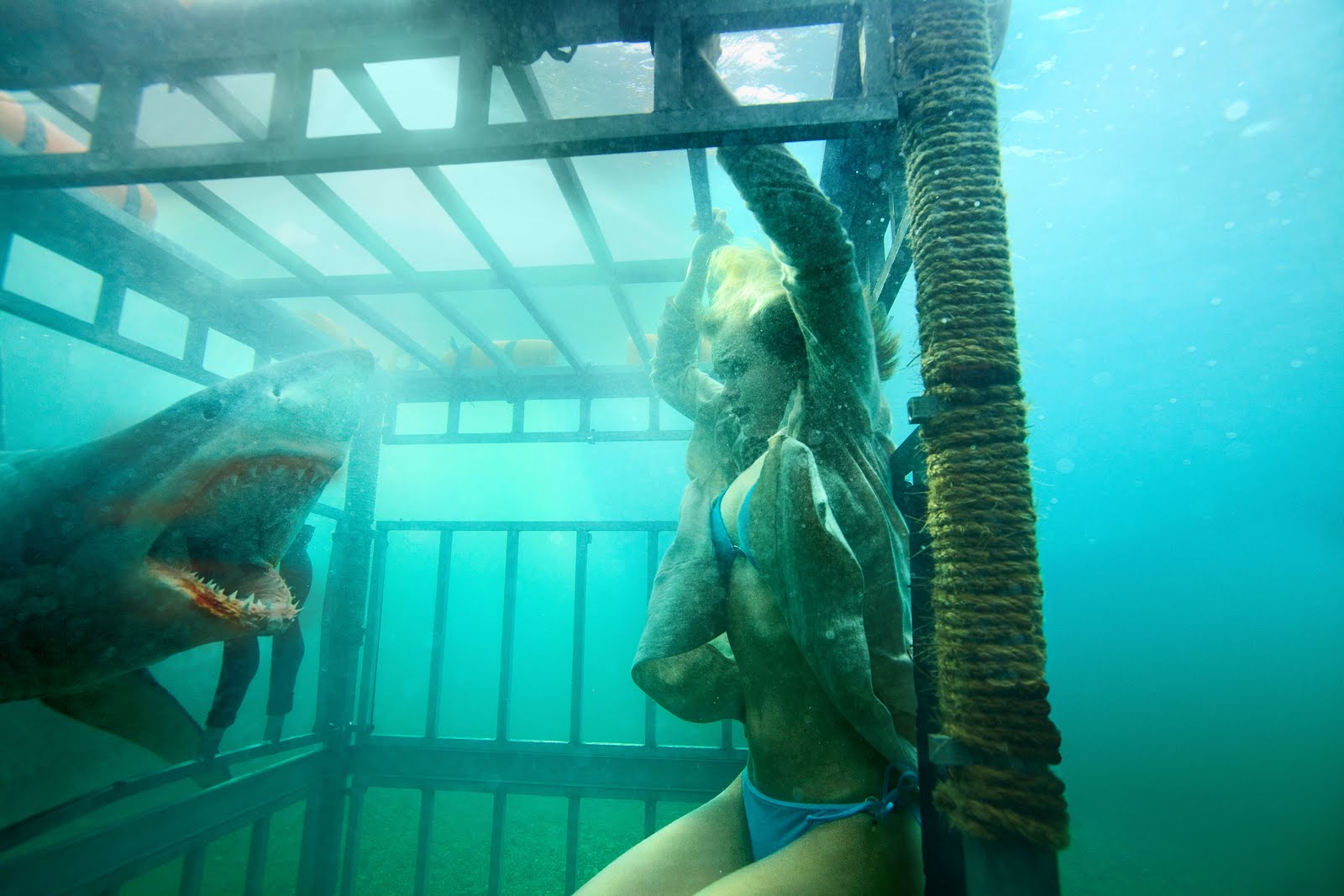
Unfortunately, I missed Shark Night when it was in theaters in 3D. I had to settle for the 2D DVD version. Even this was pretty good.
Much of the purpose of a film like Shark Night is to ogle bodies, and the bodies here are nicely formed. There are the bikini-clad babes, the buff young men, and, of course, the sharks, fierce CGI-and-animatronic creations with stiff fins and ugly teeth. A particularly nice body is that of the lead, Sara Paxton, who plays a college girl named Sara. Shark Night is the type of movie in which, during the day, Sara wears a bikini and then at night, to cover up, she puts on an unbuttoned sweater and continues to wear the bikini.
Also of interest is the way the film mixes subgenres to create a brew that is, if not original, at least up to date. The film is a mix of slasher film, torture porn, southern Gothic, and berserk biota. Like the Friday the 13th-type slasher films, a group of friends (this time from college) go off for a pleasant lakeside getaway, with the intention of having lots of sex. Instead they get slashed, this time by the hungry sharks that inhabit the lake. Like Hostel-type torture porn, the group of friends is tormented by a cabal of sadistic bad guys who have planted the sharks in the lake to make snuff films to distribute on the Internet. Like Deliverance-type southern Gothic, the bad guys are backwoods southerners (this time in the Louisiana bayous). Like Jaws-type berserk biota, the chief agents of destruction are animals preying on people, sharks.
There are many mysteries to Shark Night. How exactly did the bad guys, who do not seem like the brightest bulbs in the bayous, manage to collect all these sharks and populate the lake with them? Did anyone ever settle the issue of how saltwater sharks manage to live in a freshwater lake (the question is discussed feverishly in the film, then abandoned to provide more time for escaping from sharks)? How did Tulane University get convinced to allow Shark Night to use its logo? Was it a good career move for Katharine McPhee to strip to her underwear in the film? It must have been, because she now has her own TV series, Smash.
Shark Night is reminiscent of another recent film, the 2010 remake of Piranha, but I enjoyed it more because it did more with less. It is no Jaws--it is not even Deep Blue Sea--but it is entertaining.
George Ochoa
Author
Deformed and Destructive Beings: The Purpose of Horror Films
Much of the purpose of a film like Shark Night is to ogle bodies, and the bodies here are nicely formed. There are the bikini-clad babes, the buff young men, and, of course, the sharks, fierce CGI-and-animatronic creations with stiff fins and ugly teeth. A particularly nice body is that of the lead, Sara Paxton, who plays a college girl named Sara. Shark Night is the type of movie in which, during the day, Sara wears a bikini and then at night, to cover up, she puts on an unbuttoned sweater and continues to wear the bikini.
Also of interest is the way the film mixes subgenres to create a brew that is, if not original, at least up to date. The film is a mix of slasher film, torture porn, southern Gothic, and berserk biota. Like the Friday the 13th-type slasher films, a group of friends (this time from college) go off for a pleasant lakeside getaway, with the intention of having lots of sex. Instead they get slashed, this time by the hungry sharks that inhabit the lake. Like Hostel-type torture porn, the group of friends is tormented by a cabal of sadistic bad guys who have planted the sharks in the lake to make snuff films to distribute on the Internet. Like Deliverance-type southern Gothic, the bad guys are backwoods southerners (this time in the Louisiana bayous). Like Jaws-type berserk biota, the chief agents of destruction are animals preying on people, sharks.
There are many mysteries to Shark Night. How exactly did the bad guys, who do not seem like the brightest bulbs in the bayous, manage to collect all these sharks and populate the lake with them? Did anyone ever settle the issue of how saltwater sharks manage to live in a freshwater lake (the question is discussed feverishly in the film, then abandoned to provide more time for escaping from sharks)? How did Tulane University get convinced to allow Shark Night to use its logo? Was it a good career move for Katharine McPhee to strip to her underwear in the film? It must have been, because she now has her own TV series, Smash.
Shark Night is reminiscent of another recent film, the 2010 remake of Piranha, but I enjoyed it more because it did more with less. It is no Jaws--it is not even Deep Blue Sea--but it is entertaining.
George Ochoa
Author
Deformed and Destructive Beings: The Purpose of Horror Films
Sunday, February 26, 2012
Keep Watching the Skies
Before there was The Thing (2011) with Mary Elizabeth Winstead, before there was The Thing (1982) with Kurt Russell, there was The Thing from Another World (1951), a horror movie that deserves to be remembered.
It didn't have the flamboyant shape-shifting special effects or the greater fidelity to the source material (a novella by John W. Campbell, Jr.) found in the 1982 The Thing, directed by John Carpenter. What it did have was Howard Hawks, the great studio-era director whose Winchester Pictures produced The Thing from Another World. Credited as producer, Hawks did not officially direct The Thing from Another World--that credit goes to Christian Nyby. But it has long been thought that he might have directed it for Nyby, and at the least his influence is all over it. It has rapid-fire dialogue in which characters interrupt one another; a focus on men in action; a feisty love interest who talks back to her man; and a curiosity and skepticism about scientists--all hallmarks of Hawks. Above all, it has the tension and style of the master cinematic story-teller.
The Thing from Another World is about an alien buried in Arctic ice who is dug up and accidentally restored to life. A plant-based life form who looks something like Karloff's Frankenstein monster (heavy brow, flat head, big physique)--although he is never seen clearly in the film--the Thing goes ravaging through an army base, seeking the blood on which it lives. Guns won't kill it, and a debate goes on between the soldiers and the chief scientist about whether it should be killed at all or reasoned with. This being a horror movie, reasoning with the creature does not win the day.
There are no stars in the cast, unless you count James Arness as the Thing. Then unknown, he went on to star for two decades as Matt Dillon in TV's Gunsmoke. Other than that, the players were competent character actors who did a good job making the outlandish story believable. With the ending came one of the most memorable lines in horror and science fiction history, a warning called in by a reporter to the outside world: "Keep watching the skies!"
George Ochoa
Author
Deformed and Destructive Beings: The Purpose of Horror Films
It didn't have the flamboyant shape-shifting special effects or the greater fidelity to the source material (a novella by John W. Campbell, Jr.) found in the 1982 The Thing, directed by John Carpenter. What it did have was Howard Hawks, the great studio-era director whose Winchester Pictures produced The Thing from Another World. Credited as producer, Hawks did not officially direct The Thing from Another World--that credit goes to Christian Nyby. But it has long been thought that he might have directed it for Nyby, and at the least his influence is all over it. It has rapid-fire dialogue in which characters interrupt one another; a focus on men in action; a feisty love interest who talks back to her man; and a curiosity and skepticism about scientists--all hallmarks of Hawks. Above all, it has the tension and style of the master cinematic story-teller.
The Thing from Another World is about an alien buried in Arctic ice who is dug up and accidentally restored to life. A plant-based life form who looks something like Karloff's Frankenstein monster (heavy brow, flat head, big physique)--although he is never seen clearly in the film--the Thing goes ravaging through an army base, seeking the blood on which it lives. Guns won't kill it, and a debate goes on between the soldiers and the chief scientist about whether it should be killed at all or reasoned with. This being a horror movie, reasoning with the creature does not win the day.
There are no stars in the cast, unless you count James Arness as the Thing. Then unknown, he went on to star for two decades as Matt Dillon in TV's Gunsmoke. Other than that, the players were competent character actors who did a good job making the outlandish story believable. With the ending came one of the most memorable lines in horror and science fiction history, a warning called in by a reporter to the outside world: "Keep watching the skies!"
George Ochoa
Author
Deformed and Destructive Beings: The Purpose of Horror Films
Saturday, February 18, 2012
Sexual Parasites
Horror movies have mixed attitudes toward sex. The slasher subgenre is always showing teenagers having sex, then slaughtering those teenagers, leading the slasher movie Scream to articulate the horror movie rule, "You can never have sex." Whereas such movies suggest that the slasher disapproves of sex, other horror movie monsters seem to like sex--or at least iconic images of sex. Dracula is always biting women on the neck and sucking their blood, in a kind of metaphor for sex. However, my vote for the most peculiar horror movie take on sex is They Came from Within (aka Shivers, 1975), an early work by Canadian director David Cronenberg. What makes it so strange is that its deformed destructive being (DDB) is a parasite that causes people to want to have sex.
They Came from Within takes place at a high-rise apartment complex near Montreal. A mad scientist who believes humans have become too cerebral, out of touch with their bodies, devises a parasite that will make people crave sex. The wormlike parasite lives in people's bodies and spreads from person to person by kissing, blood, grates, drains, and other vectors. The parasites infest the building and soon people are running around sexually attacking each other, spreading more parasites, and generally creating chaos. A doctor who works in a clinic at the building tries to stop the madness, but is ultimately sucked in by it. A closing newscast suggests that the infected sex zombies are spreading out to the larger area of Montreal.
The movie occupies an interesting place in movie history. The shuffling mindlessness of the sex zombies owes a debt to Night of the Living Dead, but otherwise the film is starkly original, particularly in its portrayal of the parasites. The wriggling creatures, who can burst from chests and leap onto faces, are a probable inspiration for the alien in Alien.
What is most interesting about They Came from Within is its attitude toward sex. The premise seems bizarre: a mad scientist thinks people don't have enough desire for sex? Has he ever been in high school? Or college? People seem to have plenty of desire for sex. Yet in this movie, one can almost see what he means. The doctor, for example, has an attractive nurse girlfriend who strips in front of him without arousing any interest. Only when the sex-zombified girlfriend attacks him, and presumably infects him, does he have a chance of recovering his own libido. The movie appears to be siding with the mad scientist--regarding modern humans as undersexed, and requiring that they take a dose, however disgusting and horrible it may seem, of old-fashioned carnality.
George Ochoa
Author
Deformed and Destructive Beings: The Purpose of Horror Films
They Came from Within takes place at a high-rise apartment complex near Montreal. A mad scientist who believes humans have become too cerebral, out of touch with their bodies, devises a parasite that will make people crave sex. The wormlike parasite lives in people's bodies and spreads from person to person by kissing, blood, grates, drains, and other vectors. The parasites infest the building and soon people are running around sexually attacking each other, spreading more parasites, and generally creating chaos. A doctor who works in a clinic at the building tries to stop the madness, but is ultimately sucked in by it. A closing newscast suggests that the infected sex zombies are spreading out to the larger area of Montreal.
The movie occupies an interesting place in movie history. The shuffling mindlessness of the sex zombies owes a debt to Night of the Living Dead, but otherwise the film is starkly original, particularly in its portrayal of the parasites. The wriggling creatures, who can burst from chests and leap onto faces, are a probable inspiration for the alien in Alien.
What is most interesting about They Came from Within is its attitude toward sex. The premise seems bizarre: a mad scientist thinks people don't have enough desire for sex? Has he ever been in high school? Or college? People seem to have plenty of desire for sex. Yet in this movie, one can almost see what he means. The doctor, for example, has an attractive nurse girlfriend who strips in front of him without arousing any interest. Only when the sex-zombified girlfriend attacks him, and presumably infects him, does he have a chance of recovering his own libido. The movie appears to be siding with the mad scientist--regarding modern humans as undersexed, and requiring that they take a dose, however disgusting and horrible it may seem, of old-fashioned carnality.
George Ochoa
Author
Deformed and Destructive Beings: The Purpose of Horror Films
Sunday, February 12, 2012
Horror vs. Action
Lately I've been writing about action films, and it occurs to me there is much overlap between that genre and horror. Both are centrally concerned with the struggle between more or less normal characters and some kind of destructive nemesis. Both usually involve violence and fear.
The main difference is in the primary purpose of each genre--what it is principally trying to do. The horror film's primary purpose is the presentation of a deformed destructive being (DDB), ie, the monster. The action film's primary purpose is the presentation of a physical fight between a hero and a villain. The horror film mainly wants to show you the monster; the action film wants to show you a fight. This difference is marked between two closely connected films, Alien (1979) and Aliens (1986).
Alien is the story of a grotesque extraterrestrial that gets aboard a spaceship and starts killing the crew one by one. Though the DDB is rarely shown in full detail, the focus of the movie is this monster, and the prevailing feeling is one of fear. Attempts to fight the alien with makeshift weapons are mostly ineffectual. At the end, the final girl, Ripley (Sigourney Weaver), barely manages to defeat the alien by having it sucked into space. Alien is clearly a horror movie: it is all about the DDB.
Aliens, the first and best sequel to Alien, is also about the species of extraterrestrials that caused such havoc in the first film. Weaver returns as Ripley to contront the creatures again. But this time she is accompanied by a squad of space marines wielding heavy weaponry. In a series of dynamite action scenes on a desolate planet, she and the marines wage battle against hordes of aliens, only to find themselves outfought. The few survivors devise a plan to leave. With minutes ticking before the area is about to undergo nuclear explosion, Ripley has to stay and fight more aliens in single combat--including the dreaded alien queen--to protect a little girl, Newt. Ripley and Newt escape on their spaceship, only for Ripley to have to face the alien queen again. Ripley does so in a mechanical loader that resembles yellow battle armor. After exchanging punches, Ripley again forces the alien to be sucked into space.
The difference is tremendous. Aliens is not a horror movie at all--it is an action movie. The point is not primarily to show the DDB but to show the hero (Ripley and her marines) having one physical fight after another with the villain (the alien queen and her aliens). Ripley's heroism is emphasized by giving her a child to protect; the alien queen's villainy is emphasized by having her focus on attacking the child. Alien and Aliens show how closely the horror movie and the action movie are linked--so closely that one can be transformed into another with the addition of a few more weapons and some space marines.
George Ochoa
Author
Deformed and Destructive Beings: The Purpose of Horror Films
The main difference is in the primary purpose of each genre--what it is principally trying to do. The horror film's primary purpose is the presentation of a deformed destructive being (DDB), ie, the monster. The action film's primary purpose is the presentation of a physical fight between a hero and a villain. The horror film mainly wants to show you the monster; the action film wants to show you a fight. This difference is marked between two closely connected films, Alien (1979) and Aliens (1986).
Alien is the story of a grotesque extraterrestrial that gets aboard a spaceship and starts killing the crew one by one. Though the DDB is rarely shown in full detail, the focus of the movie is this monster, and the prevailing feeling is one of fear. Attempts to fight the alien with makeshift weapons are mostly ineffectual. At the end, the final girl, Ripley (Sigourney Weaver), barely manages to defeat the alien by having it sucked into space. Alien is clearly a horror movie: it is all about the DDB.
Aliens, the first and best sequel to Alien, is also about the species of extraterrestrials that caused such havoc in the first film. Weaver returns as Ripley to contront the creatures again. But this time she is accompanied by a squad of space marines wielding heavy weaponry. In a series of dynamite action scenes on a desolate planet, she and the marines wage battle against hordes of aliens, only to find themselves outfought. The few survivors devise a plan to leave. With minutes ticking before the area is about to undergo nuclear explosion, Ripley has to stay and fight more aliens in single combat--including the dreaded alien queen--to protect a little girl, Newt. Ripley and Newt escape on their spaceship, only for Ripley to have to face the alien queen again. Ripley does so in a mechanical loader that resembles yellow battle armor. After exchanging punches, Ripley again forces the alien to be sucked into space.
The difference is tremendous. Aliens is not a horror movie at all--it is an action movie. The point is not primarily to show the DDB but to show the hero (Ripley and her marines) having one physical fight after another with the villain (the alien queen and her aliens). Ripley's heroism is emphasized by giving her a child to protect; the alien queen's villainy is emphasized by having her focus on attacking the child. Alien and Aliens show how closely the horror movie and the action movie are linked--so closely that one can be transformed into another with the addition of a few more weapons and some space marines.
George Ochoa
Author
Deformed and Destructive Beings: The Purpose of Horror Films
Wednesday, February 1, 2012
Announcing the New Year's Contest Winner
Jon T has been selected by random drawing to win a free copy of Deformed and Destructive Beings: The Purpose of Horror Films. Congratulations, Jon T! To claim your prize, email me at bkarloff1@gmail.com with your postal mailing address. I will send the book to that address.
Thanks to everyone who participated in the New Year's Contest.
George Ochoa
Thanks to everyone who participated in the New Year's Contest.
George Ochoa
Subscribe to:
Posts (Atom)